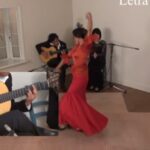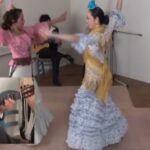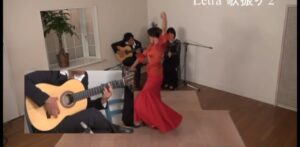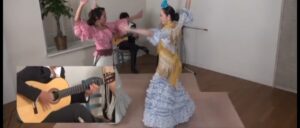
Soleá means solitude. It is slow, it is heavy, and for a dancer it is the palo where every step has weight. For the guitarist it is the palo where every note has to be precise, because there is nowhere to hide at this tempo.
This is a lesson on the basic soleá compás from my course. The original audio is Japanese; use the written notes below, and check the player for available caption tracks.
The shapes
Two chords carry the basic compás: E, and an F played without the full barre. Leaving F unbarred gives it the thick, dark sound that soleá needs. The right hand uses the thumb and the ring finger: three downstrokes, then a ring-finger downstroke before the thumb on F, then the slur run on the 4th string (open, 1st, 2nd, 3rd fret) and the golpe that closes the compás on 10.
Why dancers care
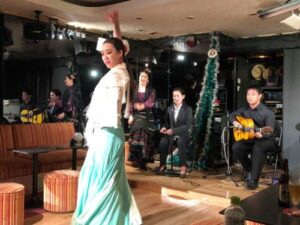
A dancer counts the twelve beats through your accents on 3, 6, 8, 10 and 12. If the accents are clean, the dancer can mark, walk, and prepare the llamada without looking at you. If they are not, the dancer has to listen instead of dance. That is the whole job: make the compás so clear that the dancer forgets you are there.
The full course
Accompany the Dance: Soleá (Vol.6) walks through a complete soleá with a real dancer and singer: salida, letras, escobilla, falsetas and the bulerías ending, section explanations in the original Japanese audio, the model performance and play-along videos without the guitar. The 48-page English booklet has the score, TAB and translated letras. English CC tracks are being added; full in-player coverage is not yet verified. If you need English captions for every lesson, please wait until coverage is confirmed.
Start free: watch the 36-second Soleá accompaniment sample and listening exercise, or try the free Sevillanas lesson and guitar-free practice. No signup is needed. Browse all 18 sample topics.
Toshi Ikegawa, flamenco guitarist, Tokyo. Questions: info@vivafla.jp.